What I do in one sentence: I follow the principle from The Neverending Story: “Do what you want,” meaning I pay attention to what my current work in visual art or literature needs and then follow that.
Why I didn’t get a proper 9–5 job: Because it doesn’t make sense to me. It consumes an enormous amount of time, and time is my most valuable resource. Life is an accumulation of ordinary days, so each of my days should include at least one conscious, meaningful decision — starting with how I choose to work.
An artwork I would get accomplished if space, time and money were abundant: A beautiful, inclusive columbarium for everyone, inspired by the atmosphere of Piranesi’s etchings — a shared resting place where people are treated equally in death, reflecting on space, inequality, and how we relate to nature and memory.
Why I do what I do: Because it feels both meaningful and easy to me. Meaningful, because it allows me to pose and grapple with questions and problems that might otherwise drive me to despair—even though I can’t answer or solve them on my own, of course, I see art (all forms of art, including literature, of course) as a way to explore something and, above all, to seek and find connection—to others, but also to myself. And it’s usually easy because the things that are part of a “normal” life (and that often seem easy for others) are much more complicated and uninteresting to me than simply devoting myself to a new obsession.
Artists I have on my watch list (and why): Johanna Seidel (Dresden) – I recently saw her exhibition *Gardens at Night* at Laetitia Gorsky in Leipzig and was so hooked that I went back to see it again and take it all in as best I could. Something about these fairy-tale-like, romantic, and at the same time ominous worlds felt so familiar to me, and yet it was new to me to have this kind of access to them. I wish I had this exhibition just around the corner (I live above a whole lot of gardens that are within gardens—it would somehow fit) and could see it anytime, like a medicine.
Rebecca Grundmann (Berlin) – We know each other from our time at art school, so I’ve been familiar with her somewhat poetic, humorous, and clear works for a while now. When I was in Berlin recently, we met to talk about food for my blog, and she had a drawing with her that was also a recipe—actually a scrap of paper, but also something you can always carry with you and perhaps should, to keep it and yourself alive—maybe like a talisman. That’s something that never ceases to amaze me about art: that objects are declared so sacred that they become untouchable and, at a certain point, inaccessible to most people—it seems to me to be the opposite of the origin and purpose of artistic work. That’s why I can’t stop thinking about the drawing in my pants pocket, my jacket pocket, about warm, crumpled paper, and the recipe.
Lena Anouk Philipp (Berlin) – I visited Lena some time ago in her studio in Cologne—partly for my blog—and we looked at her paintings, sketchbooks, and drawings, wondering if she paints the way I write. To make a start and explore the world that emerges in the process: something I don’t dare to do in painting. The corridor in the painting, which grows increasingly narrow, especially toward the end, seemed very constricting to me, and painting felt like a physically exhausting act. That’s not a bad thing in itself, of course—but I don’t find that heaviness in Lena’s paintings: They have their own light, their own gravity and mythology; they could stem from a coherent, infinite narrative and yet all stand on their own. Above all, the way she paints light fascinates me greatly.
I am afraid of mostly fear itself — especially the way fear can restrict life. Also fear of men, and fear of death in the abstract sense, but primarily the fear of letting fear take over and limit how fully I live.
I know that a piece is finished when it becomes something separate from me — when it feels like it is looking back at me and I have nothing left to do.
How I want to be buried resp. words I want to be written on my tombstone: I would like to be cremated, with any usable organs donated beforehand, and placed in a self-designed columbarium. I don’t yet know the exact words for a tombstone — a close friend who creates stickers may choose one for me.
How do I imagine my life in old age: I hope to be in good health for the most part and surrounded by my “Loved Ones” — with a capital L — just as I am now 🙂 So far, my life has steadily gotten better, and I am very happy and grateful for the opportunities I have and everything I can discover and experience. I hope that as an older person, I can say that I have cherished this serendipitous happiness, that I have lived up to it, and that I have done as much as possible to ensure that others around me and after me can also live this life. And that I understand when it is time to make room for these others and to fully support them in finding and filling their own place—even if, due to my age, I may no longer fully understand them.
What role does work play in my life as I get older: In the past, my artistic work and constantly thinking about it were my sole focus and my only goal. That probably has a lot to do with the fact that I defined myself solely through it and felt I had to prove my right to exist, but of course also with ego. Now I think that it is part of my work and my profession as an artist to protect my work from my ego and external demands, at least to the extent that I can continue doing it. And I want to do that because working makes me happy. And since that is the only good reason to work on anything artistic at all, I try not to define myself by it anymore and to see and treat my work as something independent and as an activity, not as an outcome.
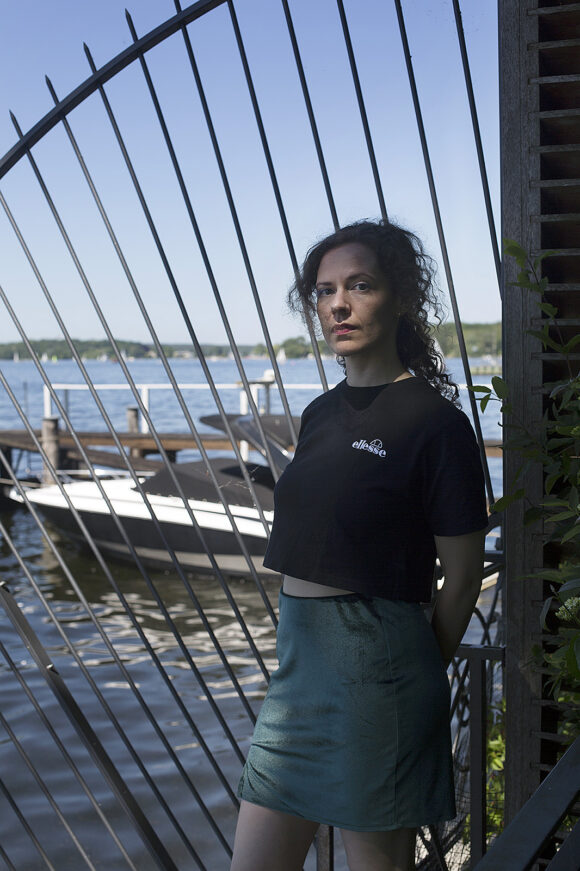
Thea Mantwill, Fellow at the Literarisches Colloquium Berlin. Studio visit, May 2026.
My studio is my bed and my desk.
What I do in one sentence: I follow the principle from The Neverending Story: “Do what you want,” meaning I pay attention to what my current work in visual art or literature needs and then follow that.
Why I didn’t get a proper 9–5 job: Because it doesn’t make sense to me. It consumes an enormous amount of time, and time is my most valuable resource. Life is an accumulation of ordinary days, so each of my days should include at least one conscious, meaningful decision — starting with how I choose to work.
An artwork I would get accomplished if space, time and money were abundant: A beautiful, inclusive columbarium for everyone, inspired by the atmosphere of Piranesi’s etchings — a shared resting place where people are treated equally in death, reflecting on space, inequality, and how we relate to nature and memory.
Why I do what I do: Because it feels both meaningful and easy to me. Meaningful, because it allows me to pose and grapple with questions and problems that might otherwise drive me to despair—even though I can’t answer or solve them on my own, of course, I see art (all forms of art, including literature, of course) as a way to explore something and, above all, to seek and find connection—to others, but also to myself. And it’s usually easy because the things that are part of a “normal” life (and that often seem easy for others) are much more complicated and uninteresting to me than simply devoting myself to a new obsession.
Artists I have on my watch list (and why): Johanna Seidel (Dresden) – I recently saw her exhibition *Gardens at Night* at Laetitia Gorsky in Leipzig and was so hooked that I went back to see it again and take it all in as best I could. Something about these fairy-tale-like, romantic, and at the same time ominous worlds felt so familiar to me, and yet it was new to me to have this kind of access to them. I wish I had this exhibition just around the corner (I live above a whole lot of gardens that are within gardens—it would somehow fit) and could see it anytime, like a medicine.
Rebecca Grundmann (Berlin) – We know each other from our time at art school, so I’ve been familiar with her somewhat poetic, humorous, and clear works for a while now. When I was in Berlin recently, we met to talk about food for my blog, and she had a drawing with her that was also a recipe—actually a scrap of paper, but also something you can always carry with you and perhaps should, to keep it and yourself alive—maybe like a talisman. That’s something that never ceases to amaze me about art: that objects are declared so sacred that they become untouchable and, at a certain point, inaccessible to most people—it seems to me to be the opposite of the origin and purpose of artistic work. That’s why I can’t stop thinking about the drawing in my pants pocket, my jacket pocket, about warm, crumpled paper, and the recipe.
Lena Anouk Philipp (Berlin) – I visited Lena some time ago in her studio in Cologne—partly for my blog—and we looked at her paintings, sketchbooks, and drawings, wondering if she paints the way I write. To make a start and explore the world that emerges in the process: something I don’t dare to do in painting. The corridor in the painting, which grows increasingly narrow, especially toward the end, seemed very constricting to me, and painting felt like a physically exhausting act. That’s not a bad thing in itself, of course—but I don’t find that heaviness in Lena’s paintings: They have their own light, their own gravity and mythology; they could stem from a coherent, infinite narrative and yet all stand on their own. Above all, the way she paints light fascinates me greatly.
I am afraid of mostly fear itself — especially the way fear can restrict life. Also fear of men, and fear of death in the abstract sense, but primarily the fear of letting fear take over and limit how fully I live.
I know that a piece is finished when it becomes something separate from me — when it feels like it is looking back at me and I have nothing left to do.
How I want to be buried resp. words I want to be written on my tombstone: I would like to be cremated, with any usable organs donated beforehand, and placed in a self-designed columbarium. I don’t yet know the exact words for a tombstone — a close friend who creates stickers may choose one for me.
How do I imagine my life in old age: I hope to be in good health for the most part and surrounded by my “Loved Ones” — with a capital L — just as I am now 🙂 So far, my life has steadily gotten better, and I am very happy and grateful for the opportunities I have and everything I can discover and experience. I hope that as an older person, I can say that I have cherished this serendipitous happiness, that I have lived up to it, and that I have done as much as possible to ensure that others around me and after me can also live this life. And that I understand when it is time to make room for these others and to fully support them in finding and filling their own place—even if, due to my age, I may no longer fully understand them.
What role does work play in my life as I get older: In the past, my artistic work and constantly thinking about it were my sole focus and my only goal. That probably has a lot to do with the fact that I defined myself solely through it and felt I had to prove my right to exist, but of course also with ego. Now I think that it is part of my work and my profession as an artist to protect my work from my ego and external demands, at least to the extent that I can continue doing it. And I want to do that because working makes me happy. And since that is the only good reason to work on anything artistic at all, I try not to define myself by it anymore and to see and treat my work as something independent and as an activity, not as an outcome.
Thea Mantwill, Fellow at the Literarisches Colloquium Berlin. Studio visit, May 2026.